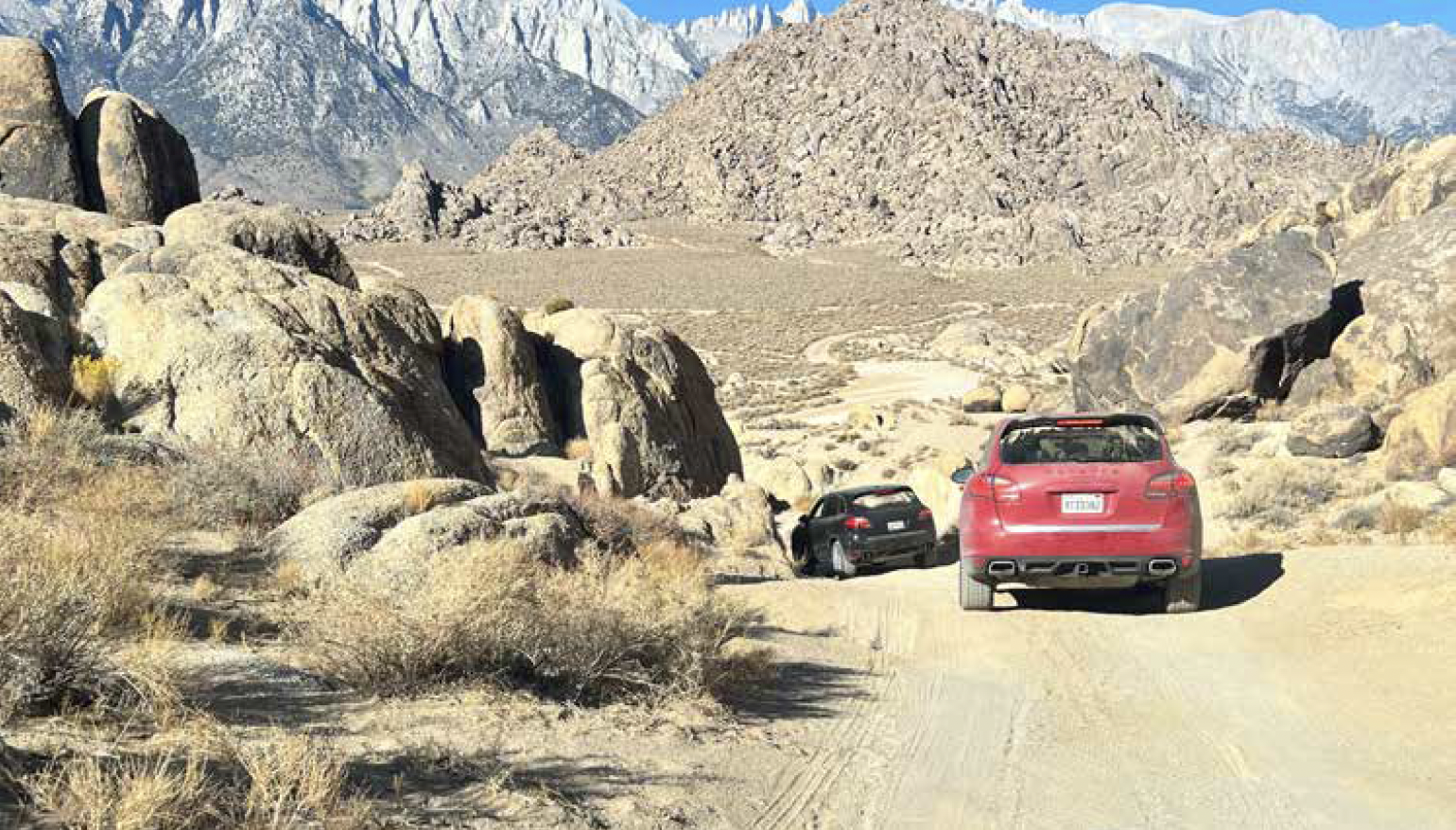
Porsche passion exists for all models of Porsches in our region, especially the SUVs. The Cayenne has always been one of the most practical and useful of the Porsche models for the tasks of day to day life, but the Cayenne also possesses on road and off-road driving dynamics that makes these SUVs exciting as a different type of Porsche sports cars.
In October, seven Cayennes went on an adventure to explore some of the lesser known cultural and natural landmarks in remote areas of Central California. Due to the long distance of almost 600 miles, this off-road tour event was a two-day event starting on a Saturday morning with a several hour freeway drive to reach Victorville, CA. The comfortable ride in the Cayennes makes the freeway miles go by effortlessly.
Once gassed up in Victorville, and bellies stuffed at a delicious local burger joint, the group of Cayennes hit the winding and high speed Highway 395, traveling for about an hour before reaching its first turnoff from the pavement, somewhere in the Mojave Desert.
Second generation Cayennes make the transition from onroad to off-road with minimal effort: hit your turn signal to get off the pavement, click the center console button to activate off-road mode, roll up your windows to keep out the dust, and start down the dirt roads into the hills heading into the middle of nowhere. The roads we took were so far in the middle of nowhere that unless iPhone GPS maps were pre-downloaded far ahead of time, the phone navigation apps were useless. Sometimes it’s fun to recognize the utility of old technology: the 958 Cayenne uses a DVD to provide its map data for navigation, so while the iPhone apps were of no use as a guide, the in-car navigation on the Cayenne’s PCM worked beautifully, keeping us on route.
As it goes with off-road driving, maps can show the presence of a passable road, but often the terrain changes frequently: it had rained a number of days prior to our drive, and the rains had aggressively carved out ruts into the ground in a few areas that required the group to change course to get around some extremely deep ruts and drop-offs. Cayennes are incredibly capable in their stock form, but they do have their ground clearance limits, and since we all love our Cayennes, the group didn’t feel bad about turning around a couple times and finding other less risky ways to make progress toward our destination.
The first official landmark stop was called the Major Michael Adams X-15 Memorial, which was where a space program test pilot’s crashed fuselage landed in the desert back in 1967. This memorial was constructed in 2004 by a Boy Scout troop and is down a bumpy and rutted dirt road. Our group stopped to read the very interesting information at the memorial site, as well as check out the posted plaque that was made out of Inconel-X, the same material that the actual X-15 rocket plane was made out of.
Following the memorial stop, the group spent several hours of amazing off-road driving through the vast Spangler Hills area traveling slowly through ravines, through very deep sand washes, and over loose rocky stretches, arriving at the first of the natural landmarks, the Trona Pinnacles. The Pinnacles are rock projections made of calcium carbonate that rise up to 140 feet high from the dry lake basin region in an area that is isolated far from paved roads. There are about 500 of these rock spires in a 14 square mile area. The group of Cayennes arrived late in the day making the shadows from the rocks an incredible sight. We stopped for pictures, and then drove around the dirt roads that travel around the Pinnacles, before continuing north.
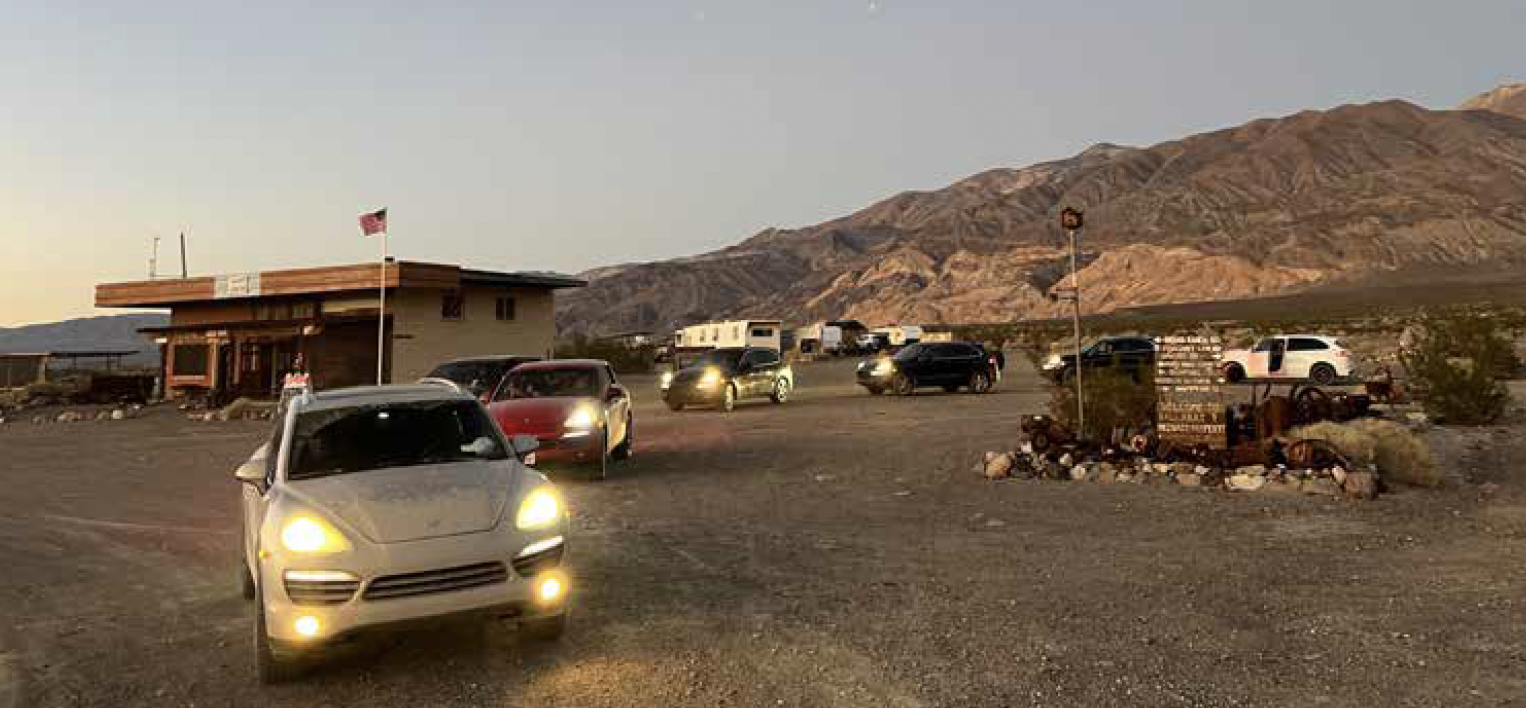
In order to try to reach the next stop before complete darkness set in (does anyone like visiting a Ghost Town at night?!), the group took to the pavement for a brisk drive to reach a turn onto a 3.6 mile stretch of high speed gravel road leading us to Ballarat Ghost town just after sundown. This small “town” had old mining machinery strewn about the roads, with a small Trading Post with mining memorabilia inside from 100 years ago when it was an active mining town. The locals were kind and friendly, and thought the dirty band of Cayennes that had been on the road for 8 hours now was a sight to see.
Our group of Cayennes continued north for over an hour on completely dark, two-lane paved roads, to reach the town of Lone Pine. For the first time I used the headlight washers on the Cayenne to try to increase the headlight’s effectiveness, but unfortunately the salty mud from Trona was not phased by numerous cycles of the headlight washers that used up every drop of our washer fluid. Upon reaching the small town of Lone Pine, our final adventure for the night involved trying to eat an efficient dinner, which turned out to be a total bust: it’s difficult to think that expensive Mexican food can be poorly executed, but this restaurant proved that it’s not only possible, but it can also take forever. I know I was not the only one longing for the efficient and delicious restaurant we had at lunch almost 8 hours earlier!
After a good night’s sleep, the next day was the playground day for the Cayennes, with the morning spent exploring all of the off-road obstacles and the incredible sights in the Alabama Hills region at the base of Mount Whitney. We spent several hours stopping along Movie Road, hiking the Mobius Arch Loop Trail, and taking every side shoot trail possible that went up and down steep hills, though gullies, over rocks, ruts, sand, and dirt. We had a very proud Cayenne moment when a couple off-road looking SUVs turned around after trying to take a tough trail with some steep climbs, and our pack of dusty Cayennes with their intrepid drivers cruised up and over the obstacles with no fuss. The off-road driving concluded with a tight, rocky, rutted dirt road that was at times blocked by curious cows. It took about an hour and a half to reach the Manzanar War Relocation Center Historic Site, which was the final official destination.
Along the way we passed some side-by-side ATVs that waved as we passed, and I later noticed they posted a comment on the PCA-SDR Instagram page commenting how cool our group of Cayennes was out in the dirt. Epic!
The Cayennes had all survived the adventure. In two days of driving, our 2011 Cayenne S had traveled 543 miles which took 16 hours of seat/driving time, and had only one issue, other than running out of washer fluid: 30 minutes into the first stretch of off-roading the prior day, it had a PASM failure that made the shocks all default to the absolute stiffest setting, making for a very rough couple days of driving! After an easy repair to solder a broken wire connector on one of the struts, the Crystal Silver S that was covered in Trona’s finest salty mud, is ready for the next adventure.
For almost 20 years the PCA San Diego Region has put on off-road tour events that exercise the abilities of the Cayenne while providing a chance to explore less traveled areas of San Diego, and beyond. And many of our events can also be enjoyed by drivers of Macan SUVs, as well as off-road prepared 911s. Come join us for a drive - it will probably be the most fun you can have going less than 10mph in a Porsche!